| Vitriol
Operations Alessandra
Borgogelli
Stefano
Pasquini has a relationship of total detachment from the
average outlook onto reality. Such operation does not
exclude his own critical awareness, it rather strengthens
it. This “detachment” in fact is due to a
strong sense of irony which ensures his distanced stand,
so that he can qualitatively increase his ability in
facing, in a disillusioned and uninhibited way, the facts
of the present with the certitude that the possibility of
a communication still exists. In fact Pasquini’s
incursions in various fields of reality become
explorations of social paradises which, as
“monsters”, are consumed and tossed on the
first page. 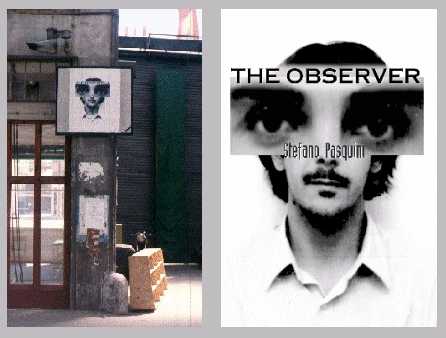 Thus sometimes simple photographs collected from
the floor are enormously enlarged and dominate from the
walls of buildings. Or by following an opposite
operation, many elements, the ones which are
“important for all”- and as an example a banal
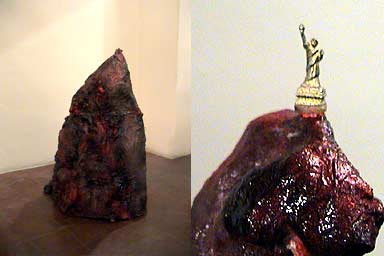
little statue of the liberty can be used- are reduced to
such a point that they can be found only with a
magnifying glass. It is anyhow a way to always put
precise problems forward: these are the actual truisms,
the obvious and self-evident truths that have the duty to
move our attention from one point to the other, and to
anesthetize the existent. In order to achieve it,
Pasquini confidently resorts to the grotesque and to the
paradox, just to induce an “upsetting” of
meaning. I was thus saying that his are vitriol
operations, that are corrosive of the phenomenological
plane of reality. By going “underneath” they
oppose the obviousness of today’s world as well as
the immense and predictable net of information, since
they act as displacing elements through more effective
visual inputs. In fact, the triggered course equals
Freudian witticisms which have the duty of letting many
certainties precipitate, and of provoking instead, as a
short circuit, an arrest in a sort of lightning of
clearness. To reach it, Pasquini often “changes
face” and descends into increasingly different
clothes to merrily escape, disguised as Spiderman or as a
banal observer with four eyes or as a mute and
blind interviewer as a “dumb servant” (Questionnaire,
2003). On the latter event, he covers his head with a
pumpkin (as a blockhead, deprived of autonomy and
intelligence). Instead of his mouth he has a closed zip
which underlines the awareness of the impossibility to
communicate. Thanks to his goodness, though, not to scare
us too much, Stefano adds Mickey Mouse eyes. How does the
interview then take place? Certainly not as the same word
would indicate, that brings us back to an operation seen
– as a matter of fact – betwe Thus sometimes simple photographs collected from
the floor are enormously enlarged and dominate from the
walls of buildings. Or by following an opposite
operation, many elements, the ones which are
“important for all”- and as an example a banal
little statue of the liberty can be used- are reduced to
such a point that they can be found only with a
magnifying glass. It is anyhow a way to always put
precise problems forward: these are the actual truisms,
the obvious and self-evident truths that have the duty to
move our attention from one point to the other, and to
anesthetize the existent. In order to achieve it,
Pasquini confidently resorts to the grotesque and to the
paradox, just to induce an “upsetting” of
meaning. I was thus saying that his are vitriol
operations, that are corrosive of the phenomenological
plane of reality. By going “underneath” they
oppose the obviousness of today’s world as well as
the immense and predictable net of information, since
they act as displacing elements through more effective
visual inputs. In fact, the triggered course equals
Freudian witticisms which have the duty of letting many
certainties precipitate, and of provoking instead, as a
short circuit, an arrest in a sort of lightning of
clearness. To reach it, Pasquini often “changes
face” and descends into increasingly different
clothes to merrily escape, disguised as Spiderman or as a
banal observer with four eyes or as a mute and
blind interviewer as a “dumb servant” (Questionnaire,
2003). On the latter event, he covers his head with a
pumpkin (as a blockhead, deprived of autonomy and
intelligence). Instead of his mouth he has a closed zip
which underlines the awareness of the impossibility to
communicate. Thanks to his goodness, though, not to scare
us too much, Stefano adds Mickey Mouse eyes. How does the
interview then take place? Certainly not as the same word
would indicate, that brings us back to an operation seen
– as a matter of fact – betwe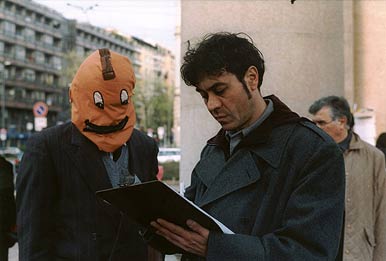 en
two or more people, where there is and interviewer and
those who are asked. The interview is mute and thus, if
we wish, not driven, but it is only made by questions
which paradoxically regard “low”, daily
problems, (Which is your favorite word?) or
problems which regard “high” facts (What do
you think of the conflict in Iraq? What is your idea
of perfect Happiness?– with a capital H). It is
a readymade of commonplaces, powerful sneers of
persuasion induced by actual communication: sometimes in
fact we can read in-between a dry and unproductive
similar question: do you cry often? Imprinted in
flags, the one which are usually meant to express and
display high-symbolical messages. That is how, from time
to time, Pasquini wears multiple personalities by letting
himself go to the continuous flow of the paradoxes of our
society. Like Marcel Duchamp, he never lets out of sight
his own objectives and shows a lucid and sarcastic
intentionality which, from uphill unifies and gives sense
to his various “manifestations” be them
administered by his videos or by his performances or by
his word games or from the height of his flags. One of
the most important points of all these energetic
“actions” is set up by a constant aesthetic
deple en
two or more people, where there is and interviewer and
those who are asked. The interview is mute and thus, if
we wish, not driven, but it is only made by questions
which paradoxically regard “low”, daily
problems, (Which is your favorite word?) or
problems which regard “high” facts (What do
you think of the conflict in Iraq? What is your idea
of perfect Happiness?– with a capital H). It is
a readymade of commonplaces, powerful sneers of
persuasion induced by actual communication: sometimes in
fact we can read in-between a dry and unproductive
similar question: do you cry often? Imprinted in
flags, the one which are usually meant to express and
display high-symbolical messages. That is how, from time
to time, Pasquini wears multiple personalities by letting
himself go to the continuous flow of the paradoxes of our
society. Like Marcel Duchamp, he never lets out of sight
his own objectives and shows a lucid and sarcastic
intentionality which, from uphill unifies and gives sense
to his various “manifestations” be them
administered by his videos or by his performances or by
his word games or from the height of his flags. One of
the most important points of all these energetic
“actions” is set up by a constant aesthetic
deple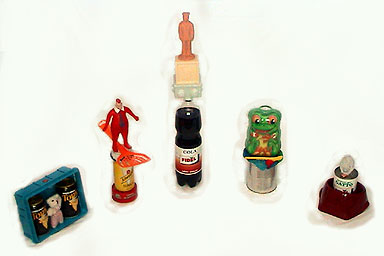 tion,
and by the consequent anesthetizing operation which makes
the artist, or better the operator, look like a sort of
alien, someone who is different, who stands out from the
average world not quite to record it but to bring it to a
crisis of consciousness, with irony and sarcasm, thus
certainly not by recurring to erudite and heavy
considerations. Such an operation corresponds per
homology to the actual dematerialization where through
the “little” the “much” is induced,
in this case by making a grimace to all certainties given
to us. His sculptural assemblages, so to say, move in
this direction, too. As a matter of fact and from time to
time Pasquini does a shopping list, he places before a
“small program” of purchases with minimum
amounts (Five $4 sculptures, including the price
of the glue needed to fix them for fear they should fly
way, 2003). Such a bricolage is based not on what
we buy and on its consequent aesthetic element, but
rather on - like a bet- is the project, that is the
amount that Pasquini makes available for himself. An
overturning of sense in the finickiness of any possible
beauty. We are dealing once again with a paradox that
teases the artistic product, the same that Pasquini
lively shows in his Unrealizable Projects. That is
how the vivacious small plastic statues “done for
nothing”, stolen for two cents from the world of
jumble sales, of the already made, finally seem to
find their own “epic”. They are unaware
that their function is to negate the epic itself by
invalidating it in the moment of its creation. This is
not in fact a struggle to produce an image, it is a poor
project. It’s like one of those poor shopping lists
that, even without a budget, can create great food and,
above all, bring new energy. tion,
and by the consequent anesthetizing operation which makes
the artist, or better the operator, look like a sort of
alien, someone who is different, who stands out from the
average world not quite to record it but to bring it to a
crisis of consciousness, with irony and sarcasm, thus
certainly not by recurring to erudite and heavy
considerations. Such an operation corresponds per
homology to the actual dematerialization where through
the “little” the “much” is induced,
in this case by making a grimace to all certainties given
to us. His sculptural assemblages, so to say, move in
this direction, too. As a matter of fact and from time to
time Pasquini does a shopping list, he places before a
“small program” of purchases with minimum
amounts (Five $4 sculptures, including the price
of the glue needed to fix them for fear they should fly
way, 2003). Such a bricolage is based not on what
we buy and on its consequent aesthetic element, but
rather on - like a bet- is the project, that is the
amount that Pasquini makes available for himself. An
overturning of sense in the finickiness of any possible
beauty. We are dealing once again with a paradox that
teases the artistic product, the same that Pasquini
lively shows in his Unrealizable Projects. That is
how the vivacious small plastic statues “done for
nothing”, stolen for two cents from the world of
jumble sales, of the already made, finally seem to
find their own “epic”. They are unaware
that their function is to negate the epic itself by
invalidating it in the moment of its creation. This is
not in fact a struggle to produce an image, it is a poor
project. It’s like one of those poor shopping lists
that, even without a budget, can create great food and,
above all, bring new energy.
Alessandra
Borgogelli teaches History of Contemporary Art at the
DAMS in Bologna. She curated historical exhibitions,
especially regarding the Italian XIXth and XXth
centuries, as well as avant-garde shows such as Parole
parole parole (Galleria Civica di Arte Contemporanea
di Trento) on the preponderance of oral and sound events
in art from the Sixties up to today.

FILI IN VISTA
Italo Zuffi
I
treni locali costeggiano gli edifici con passo
rallentato: merletti alle finestre, cespugli curati nei
giardini.
I
treni superveloci costellano di chiazze i bordi del loro
solco.
Ho
memorie dei lunghi soggiorni di Stefano a Londra.
Rispondere al telefono al Royal Albert Hall (un impiego
di cortesia, di buone maniere). Ho immagini della fugace
mostra a Birmingham. Memorie di una performance, nel
corridoio dell’ICA di Londra, nel 1997: odore di
birra e pop-corn. 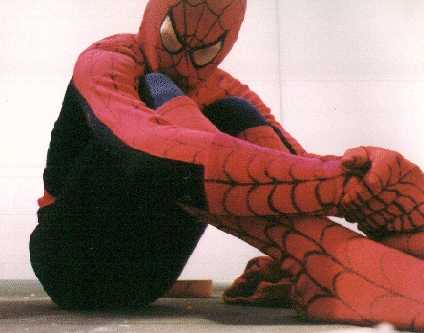 Odore di
lampade accese e umido aggrappato alle scarpe. Nessuna
parola. Solo questo richiamo dell’artista
all’essere rintanato, travasato in Inghilterra.
Contemporaneamente, fuori, nelle campagne, i cani
addentavano le volpi, tirandole fuori dalle buche nel
terreno in cui si fossero rifugiate. Stefano indossava un
abito da Uomo-Ragno fatto in casa (maldestramente: la sua
qualità). Paziente, incurante del passaggio o della
presenza dei visitatori, dei loro sguardi, del loro
pacato sconcerto, rassegnato attendeva l’arrivo dei
fox-terrier. Odore di
lampade accese e umido aggrappato alle scarpe. Nessuna
parola. Solo questo richiamo dell’artista
all’essere rintanato, travasato in Inghilterra.
Contemporaneamente, fuori, nelle campagne, i cani
addentavano le volpi, tirandole fuori dalle buche nel
terreno in cui si fossero rifugiate. Stefano indossava un
abito da Uomo-Ragno fatto in casa (maldestramente: la sua
qualità). Paziente, incurante del passaggio o della
presenza dei visitatori, dei loro sguardi, del loro
pacato sconcerto, rassegnato attendeva l’arrivo dei
fox-terrier.
C’è
sempre un’attesa per una qualche razza di cani. In
questo gli sono debitore: fatta una scelta, dichiarato
uno scopo, tirarsene poi fuori.
Seduto
sul pavimento freddo, il fazzoletto da naso ben celato da
qualche parte, pronto all’uso. Anche in questo, gli
sono debitore.
Introspezione
resa pubblica: “Do you cry often?”, (Piangi
spesso?), frase ricamata su tessuto e poi stesa
sull’erba, al sole.
Vera
arte sartoriale, la sua, anche se un po’ sghemba, un
po’ sgualcita. Fili in vista. Bordi non proprio
netti. Queste le sue qualità (il non poter rinunciare a
certe imprecisioni, tutte maschili), di cui veste i suoi
manichini (nessuno di essi proviene dal mondo
dell’arte, ma nelle sue vetrine si lascia esporre).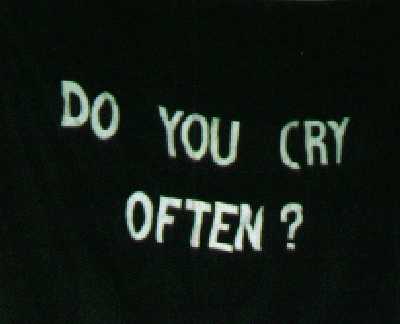
Piangi
spesso?: ma allora si danno per certi i miei pianti,
atti umidificanti.
In
questa stagione percepisco umidità in ogni cosa. Oppure:
ogni cosa si manifesta come rivestita di un velo
lacrimoso.
Stefano assorto, nel
corridoio gelato, nel suo abito rosso cangiante,
inzuppato di luce bianca. Abito self-made (un
paradosso, dopo aver lui così a lungo amato Duchamp e i
suoi “trovamenti”). Stefano intervistatore, per
le vie di Milano, mascherato. Cuciture sgualcite bene in
vista.
|
Operazioni
al Vetriolo
Alessandra Borgogelli
Stefano Pasquini ha un rapporto
di totale distacco dalla gestione normale della realtà.
Tale operazione però non esclude una sua presa di
posizione critica, piuttosto la rafforza. Il
“distacco” infatti è dovuto a un forte senso
di ironia che assicura quella presa di distanza proprio
per aumentare quantitativamente la capacità di
affrontare in modo disilluso e disinibito i fatti del
presente con la certezza che esiste una impossibilità di
comunicazione. Infatti le incursioni di Pasquini in
vari campi della realtà diventano esplorazioni di
paradisi sociali che, come i “mostri”, vengono
consumati e sbattuti in prima pagina. Ecco dunque che a
volte delle semplici fotografie raccolte da terra sono
enormemente ingrandite e dominano dalle pareti degli
edifici oppure, secondo una operazione contraria , molti
elementi , quelli “importanti per tutti”- e
valga come esempio una banale statuetta della
libertà- sono rimpiccioliti a tal punto da dovere essere
trovati con l’aiuto di una lente di ingrandimento.
Comunque si tratta sempre di un modo di mettere in campo
problemi precisi: sono questi gli attuali truismi, cioè
le verità ovvie e lapalissiane ,che hanno il compito di
spostare l’attenzione da un punto a un altro e di
anestetizzare l’esistente. Per fare ciò Pasquini
ricorre con disinvoltura al grottesco e al paradosso
proprio per indurre dei ribaltamenti di senso. Dicevo
appunto che le sue sono delle operazioni al vetriolo,
dunque corrosive del piano fenomenologico della realtà.
Andando “sotto” si oppongono alla ovvietà del
mondo di oggi e all’ immensa e scontata rete
informativa fungendo da elementi spiazzanti , da imput
visivi più efficaci. L’ iter innescato equivale
infatti a quello dei motti di spirito freudiani che
hanno il compito di fare precipitare molte certezze e che
provocano invece, per cortocircuito, una battuta
d’arresto in una specie di lampo di lucidità. Per
fare ciò Pasquini spesso “cambia faccia” e si
cala in panni via via differenti, in modo tale da potere
scappare fuori vivacemente sotto le spoglie di Spiderman
o di un banale osservatore con quattro occhi o di
un intervistatore muto e cieco come un “servo
sciocco”. In questa ultima occasione infatti si
ricopre di una testa di zucca ( da cui
“zuccone”, privo di autonomia e intelligenza).
Al posto della bocca ha una lampo chiusa che sottolinea
la coscienza della impossibilità comunicativa. Bontà
sua, però, per non farci troppa paura, Stefano vi
aggiunge occhi non vedenti da topolino. Come si svolge
dunque l’intervista? Non certamente come ci indica
il nome stesso rimandandoci a una operazione vista
appunto fra due o più persone, dove esiste un
intervistatore e coloro che vengono interpellati.
L’intervista è muta e dunque , se si vuole,
non pilotata, ma è fatta solo da domande che riguardano
paradossalmente problemi “bassi”-quotidiani
( Quale è la tua parola preferita?) oppure
problemi che riguardano fatti “alti”( Cosa
ne pensi del conflitto in Iraq?, Quale è la tua idea di
Felicità- con la lettera maiuscola- perfetta?
). Si tratta di ready made della ovvietà, di potenti
sberleffi alle convinzioni indotte dalla comunicazione
attuale: a volte infatti possiamo leggere in modo secco e
improduttivo frasi del tipo piangi spesso?
impresse in flags , quelle di solito deputate a esprimere
e sbandierare messaggi alto-simbolici. E così, di volta
in volta, Pasquini assume personalità multiple
abbandonandosi al flusso continuo dei paradossi della
nostra società. Come Marcel Duchamp, non perde mai di
vista questi suoi obbiettivi dimostrando una intenzionalità
lucida e sarcastica che, stando a monte, unifica e dà
senso alle sue varie “manifestazioni” sia che
ci vengano propinate dai suoi video che dalle sue
performance o dai suoi giochi di parole o dall’alto
delle sue bandiere.
Uno
dei punti più importanti di tutte queste
“azioni” energetiche è costituito da una
costante depauperazione estetica e da una conseguente
operazione anestetizzante che fa assomigliare
l’artista o, meglio, l’operatore a una specie
di alieno, di diverso che emerge dal mondo normale non
tanto per registrarlo quanto per metterlo in crisi di
coscienza, ma con ironia e sarcasmo, non certo facendo
ricorso a dotte e pesanti considerazioni.
Tale operazione
corrisponde, per omologia, alla smaterializzazione
attuale dove col “poco” si induce il
“molto”, in questo caso facendo uno sberleffo a
tutte le certezze che ci vengono propinate. Anche
gli assemblages scultorei , si fa per dire, si
muovono in questa direzione. In realtà Pasquini, di
volta in volta, fa la lista della spesa, si prepone un
“programmino” di acquisti con importi minimi ( Cinque
sculture da 4$ comprensive del prezzo della colla che
serve a fissarle per la paura che volino via). Un
bricolage così fatto è basato non su ciò che si compra
e sulla conseguente componente estetica , ma piuttosto su
ciò che , per scommessa, il progetto, ovvero la cifra
che Pasquini si mette di volta in volta a disposizione,
può permettere e consentire. Dunque un ribaltamento di
senso nella vanificazione di qualsiasi “bello”
possibile. Si tratta, ancora una volta, di un paradosso
che prende in giro il prodotto artistico, lo stesso che
con vivacità sempre Pasquini ci propina nei suoi Progetti
irrealizzabili . Così le vivaci statuine di plastica
“fatte di niente”, rubate per due lire al mondo
della secondarietà, del già fatto, alla fine
sembrano trovare una loro “epica” senza sapere
però che servono proprio a negare quest’ultima
invalidandola subito proprio già dalla loro
costituzione. Non si tratta infatti di un combattimento
per una qualsiasi realizzazione di immagine, ma di un
progetto povero, che ricorre a una cosalità di
comodo, simile, come accennavo, a quelle liste della
spesa che , pur in economia, vanno alla ricerca di un
“cibo” buono soprattutto a dare
nuova energia.
1989-1996
The
work of Stefano Pasquini has always been strongly
influenced by what happens  politically in the
world. In 1989 he was so shocked by the repression and massacre of the Chinese
students in Tien An Men Square that he
painted "China and You", a
symbolical representation of the destruction of their
ideal of freedom. On the 11th of September 1993, he used
his body for an installation to commemorate
the death of Stephen Biko. For eight
hours during the preview of the show, he was chained and
handcuffed, naked on the concrete floor, in the exact way
Biko was the day before his death in prison. In 1993 he
also painted an imaginary "Portrait of the Red
Brigadist", dedicated to the
great engraver Luciano De Vita. In a photographic montage
he represents himself as "The self portrait of
Ernesto Guevara". Other tributes
to political happenings include collages and drawings to commemorate
the desaparecidos in Argentina.
Another painting was titled "The last tv appearance
of JFK". In 1994 he found the group Simone Rondelet together with
Kostas Bassanos, Tiziano Tezza, Cristina Perezzani and
Caroline Creamer. The name of the group was taken at
random from the obituary page of a french paper, and the
computerized image of Mona Lisa soon became the logo for
this fictional artist, whose main aim is to increase
collaboration between different media artists and to be
known and exhibited as a solo artist from Paris, France. politically in the
world. In 1989 he was so shocked by the repression and massacre of the Chinese
students in Tien An Men Square that he
painted "China and You", a
symbolical representation of the destruction of their
ideal of freedom. On the 11th of September 1993, he used
his body for an installation to commemorate
the death of Stephen Biko. For eight
hours during the preview of the show, he was chained and
handcuffed, naked on the concrete floor, in the exact way
Biko was the day before his death in prison. In 1993 he
also painted an imaginary "Portrait of the Red
Brigadist", dedicated to the
great engraver Luciano De Vita. In a photographic montage
he represents himself as "The self portrait of
Ernesto Guevara". Other tributes
to political happenings include collages and drawings to commemorate
the desaparecidos in Argentina.
Another painting was titled "The last tv appearance
of JFK". In 1994 he found the group Simone Rondelet together with
Kostas Bassanos, Tiziano Tezza, Cristina Perezzani and
Caroline Creamer. The name of the group was taken at
random from the obituary page of a french paper, and the
computerized image of Mona Lisa soon became the logo for
this fictional artist, whose main aim is to increase
collaboration between different media artists and to be
known and exhibited as a solo artist from Paris, France.
At the
end of 1994 a very good friend of Stefano, a photographer
called Claudio Serrapica, suddenly died. As a result for
this loss, Stefano made an installation/tribute to a work
Claudio made in the seventies with the help of the povero
artist Pier Paolo Calzolari. The work was
shown at the Underwood Street Gallery of London, and then
exhibited in Bologna, Italy, where Claudio Serrapica
lived most of his life. In the same show Stefano had an
installation called "The second
dream", a reference to Piero Della Francesca, whose death
happened just a few days before Christopher Columbus
discovered the new continent. He also had a series of
unrealizeable projects in which he planned to disrupt the
underground system in
London, to transmit fake satellite news regarding a
Christo wrapping piece, to shoot the walls of a gallery
with a machine gun, to represent death with an
installation of wall graves in two rooms, where in the
second room the spectator can experience death with a
sudden darkness and loss of orientation, to set a tribute
to the 8961 political
desaparecidos of Argentina, (with a Ford Falcon
Car, which was used for their kidnapping) and to start a pirate radio that would pick up gossips from the
tables of Mason Bertaux cafe bar.
His newest works are photographs on the secret of
happiness. The titles constitute the core of the work: 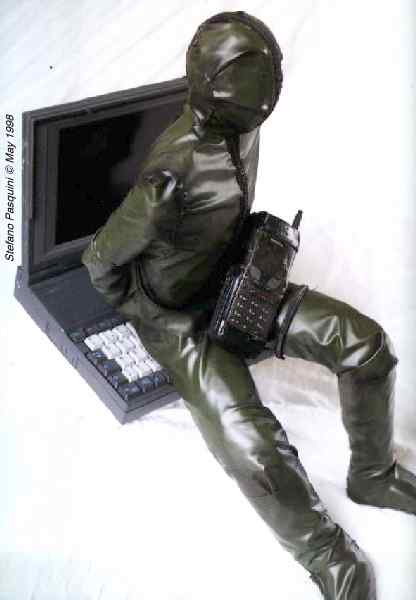 "Working at the Natural
World Carnaby Street shop as a part time sales assistant,
just after having a Benson & Hedges, I discover the
Secret of Happiness" "Walking through Old
Compton Street, listening to the Beatles, having a Benson
& Hedges, I discover the secret of Happiness" and
"Standing by the terrace
at my parents house in Casalecchio di Reno, listening to
Billy Bragg, smoking a Benson & Hedges, I discover
the Secret of Happiness." In june 1995
Stefano took part in Everything Else, a festival
organised by Alternative Arts. In a performance called
"Welcome to London" he
presented himself as Spiderman in the middle of an
identity crises, where he would be reading Sartre's
"Nausea", smelling a jumper and taking
photographs of himself. His latest works are an analysis
of the frustration and lack of communication young and
unsuccessful artists experience in everyday life, like
the flag "Do you cry often?" and
"Like a Bully boy in a
Benetton shop you're never happy with what you've got". "Working at the Natural
World Carnaby Street shop as a part time sales assistant,
just after having a Benson & Hedges, I discover the
Secret of Happiness" "Walking through Old
Compton Street, listening to the Beatles, having a Benson
& Hedges, I discover the secret of Happiness" and
"Standing by the terrace
at my parents house in Casalecchio di Reno, listening to
Billy Bragg, smoking a Benson & Hedges, I discover
the Secret of Happiness." In june 1995
Stefano took part in Everything Else, a festival
organised by Alternative Arts. In a performance called
"Welcome to London" he
presented himself as Spiderman in the middle of an
identity crises, where he would be reading Sartre's
"Nausea", smelling a jumper and taking
photographs of himself. His latest works are an analysis
of the frustration and lack of communication young and
unsuccessful artists experience in everyday life, like
the flag "Do you cry often?" and
"Like a Bully boy in a
Benetton shop you're never happy with what you've got".
|


